

Chinese Oral Exam Tips: How to Speak Confidently and Score Higher
PSLE Chinese Oral preparation should never be left to chance. Many students believe that having an extensive Chinese vocabulary or being naturally fluent in Chinese is the only way to succeed in PSLE Chinese Oral, with those who lack a Chinese-speaking environment or are less articulate always at a disadvantage.
While fluency undoubtedly gives students an edge, it is not the be-all and end-all. In reality, success in PSLE Chinese Oral also depends on a clear answering structure and the ability to express ideas effectively and logically. The good news is that these are skills that can be acquired and improved through regular practice. In this article, we will share practical strategies to help students speak more confidently and score higher in Chinese Oral examinations.
But before you go off to read this long article, you might want to download a PDF copy of it for future reference…
Why Many Students Lose Marks in Oral Exams
Before delving into the strategies, we need to first understand why students lose marks in the oral examinations. These can be broadly grouped into three categories: nervousness, poor Chinese proficiency and weak answering techniques.

#1 Nervousness
Many students are understandably nervous during oral examinations. Global estimates suggest that as many as 75% of people experience a fear of public speaking. Although an oral examination is not exactly “public speaking”, it is often an anxiety-inducing experience for many Singaporean children.
Nervousness can cause students to stutter, mumble or speak too quickly, resulting in unclear articulation. Some may speak so softly that examiners struggle to hear them. Others may pause excessively or forget the points they intended to share, losing their train of thought mid-sentence.
In some cases, nervousness can even affect how carefully students listen to the examiner. Instead of responding directly to the question asked, they may focus on whatever they had memorised and end up rambling, giving an answer that is loosely related to the topic.
Nervousness can seriously undermine students’ performance in oral examinations, even for those who are otherwise proficient in Chinese.
#2 Poor Chinese Proficiency
If a student lacks Chinese proficiency, their pronunciation and articulation may be inaccurate or unclear, affecting their fluency. They are more prone to mispronouncing characters with multiple pronunciations, such as “着”, which can be read as zhuó (“着想”) or zháo (“睡不着”) or zhe (“谈着”).

They also likely lack the appropriate vocabulary needed to describe the video or discuss the tested theme, resulting in extremely short, repetitive or overly simplistic answers. Often, they are unable to elaborate because they struggle to find the appropriate phrases, resulting in responses that are overly general.
At times, limited language proficiency may also cause students to misunderstand the examiners’ question and answer off-topic. For instance, they may not know certain key words commonly used in the questions, such as “培养”, which means to develop or cultivate.
#3 Weak Answering Techniques

Language proficiency alone is not sufficient. Good answering techniques are the other part of the equation. Without a clear answering structure, students may find themselves jumping from point to point, adding whatever comes to mind at that moment, or failing to adequately substantiate their opinions. Without regular practice, they may struggle to elaborate on their points.
Even when students have used the right vocabulary and raised relevant points, a lack of linking or signalling phrases can make the answer sound disjointed or unnatural, making it harder for the examiners to follow their line of reasoning.
How to Structure Your Answers Clearly
To avoid losing marks due to poorly organised answers, students need to rely on an answering framework.
Different question types require different approaches. For Questions 1 (video discussion) and 2 (personal response and experience-sharing), students should answer the question directly, state their point clearly, support it with relevant details and conclude appropriately. For Question 1, they need to also add on how they felt about what was depicted in the video, or what they would have done if they were at the scene.

For Question 3, students can use our “A SEAL” framework to structure their response. First, they need to answer the question directly. Next, they state their suggestions or stance, provide examples, explain and elaborate on their argument. Finally, they should link their response back to the question.
Students also need to use appropriate linking phrases to signpost each part of their answer. For example, “因为” can be used to introduce an explanation while “例如” can be used to introduce an example. These linking phrases make answers sound more natural and easier for examiners to follow.

Having a framework like “A SEAL” is important because it provides students with a clear roadmap, regardless of what question is being asked. When unsure of how to continue, they can rely on the framework to organize their thoughts and develop their responses logically and confidently, even when they feel nervous.
Improving Pronunciation and Fluency

Improving pronunciation and fluency requires consistent oral practice, not just silent preparation. Students should read Chinese passages aloud regularly to build language sense and become more familiar with natural sentence rhythm. The reading materials can be the textbook passages, school passages or those from enrichment centres.
They can also follow along with audio recordings, such as textbook passages on the Student Learning Space (SLS)—search under MOE Library. Students should imitate the speaker’s pronunciation, pauses and tone. This helps them develop a more natural speaking pace and avoid sounding flat or robotic.

Accuracy is equally important. Students should pay attention to similar-looking characters, such as “往” and “住”, as well as polyphonic words whose pronunciation changes according to context, such as “省” in “节省” and “反省”. When practising, students should slow down and focus on reading clearly and accurately before increasing their pace.
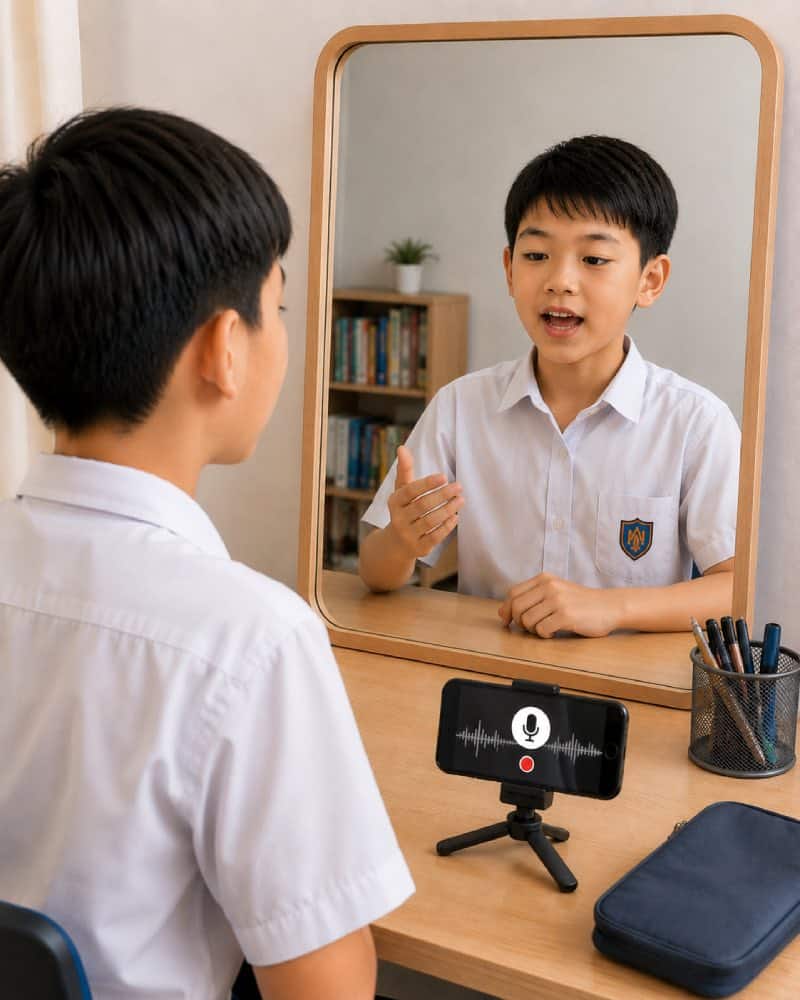
Another useful method is to practise speaking in shorter segments. Instead of forcing themselves to answer everything at once, students can practise one sentence at a time before linking their ideas together. They should also record themselves and watch their recording to identify unclear pronunciation, awkward pauses or rushed delivery. Practising in front of a mirror or with a trusted family member, friend or teacher will go a long way in helping students gain confidence. Ideally, the person assisting can also help to point out the errors the students made.

Most importantly, fluency can only be built through actual speaking practice. Students should read passages out loud and verbalise their responses to oral questions. Thinking through an answer silently or reading a passage silently may be helpful, but neither can replace actual speaking practice.
Expanding Answers with Good Vocabulary
Many students understand the question and have relevant ideas, but they struggle to express themselves clearly because their vocabulary is limited. As a result, their answers are often too short, repetitive or lacking in detail.
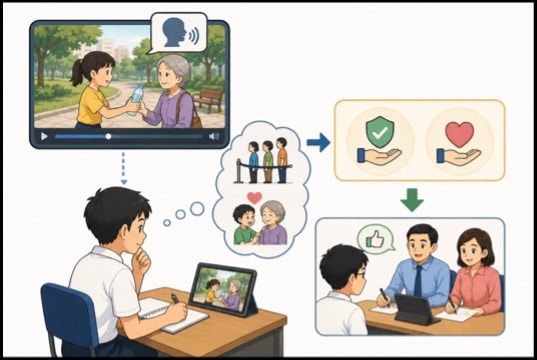
One useful strategy is to borrow key vocabulary from the video narration(旁白). If the narrator mentions terms such as “遵守秩序” (observe rules) or “关心他人” (show concern for others), students should try to incorporate these terms into their own responses, and use them as a starting point when developing their responses. This would help them stay on topic and provide more relevant ideas.
To progress, students should also replace simple words with more specific and descriptive vocabulary where appropriate. Instead of repeatedly describing an action or behaviour as “很好”, they can use terms such as “值得表扬worthy of praise /值得学习worth learning from” or “meaningful 有意义”, depending on the exact context. This makes their answers sound more mature and varied.
In addition, students should build a mental vocabulary bank for describing actions, emotions and facial expressions. Rather than simply saying someone was “开心”, students can elaborate by describing how the person smiled, laughed or felt proud of what they had done. For example, if the video showed a child with a wide grin, students can say “笑得合不拢嘴”. Such details make answers more vivid and engaging.
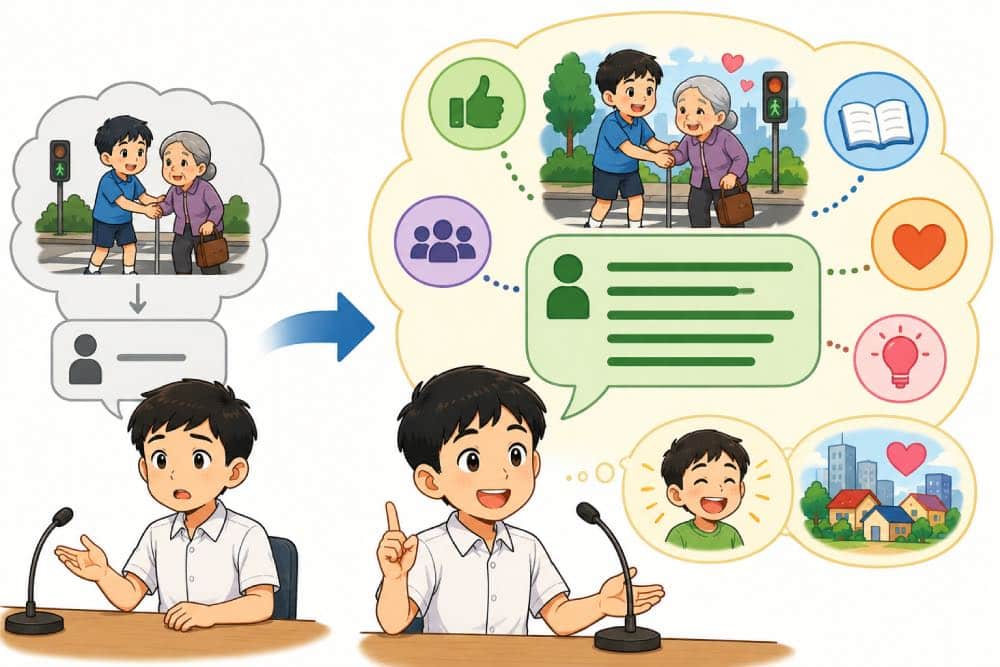
Finally, students should learn to expand their answers. Beyond giving a one-sentence response, they should think of relevant examples and further explanation. For instance, rather than saying “我认为帮助别人很重要”, they can continue with the linking phrase “因为”and then explain why helping others benefits both the individual and the community, such as helping to construct a more caring and cohesive society (“因为这样能让整个社区更有爱,让大家的关系更和谐”). This allows students to develop their ideas more fully and communicate their thoughts more effectively during the oral examination. The ability to move beyond simple statements to support ideas with relevant examples, explanations and vocabulary often distinguishes stronger oral responses from weaker ones.
Practising Under Exam Conditions
Many students spend a great deal of time memorising model answers but very little time actually speaking under exam conditions. As a result, while they may perform reasonably well during practice at home, they may struggle to perform during the examination.
To bridge this gap, students should practise responding to questions within realistic time limits, such as 30 seconds of preparation followed by a one-minute response. This helps them become more comfortable thinking and speaking under pressure. Students should also simulate the actual examination environment as closely as possible. For example, they can practise sitting in front of the laptop while speaking or answering questions with a partner (a parent, teacher or friend).

Students should also simulate the actual examination environment as closely as possible. For example, they can practise sitting in front of the laptop while speaking or answering questions with a partner (a parent, teacher or friend).
Instead of repeatedly rehearsing responses to the same questions, they should expose themselves to a variety of topics and practise responding spontaneously. The goal is not to memorise answers but to develop the ability to organise and express ideas clearly using the frameworks they have learnt, even when encountering a question for the first time.
Another effective strategy is to record and review one’s own performance. Students can record the audio or video of their responses and rewatch it to identify issues with pronunciation, fluency, content or answer structure. They may also practise with a partner, taking turns to play the role of examiner and candidate. Students can even play the role of the examiner when practising with friends. They will gain insights even with this role reversal as they have to listen to what the “candidate” says, and think of what to prompt the candidate. This will give them a better sense of the topic and its relevant vocabulary. Both students can comment on each other’s strengths and weaknesses and learn from each other.
During each practice session, it is helpful to focus on one specific area for improvement, such as pronunciation, vocabulary or answering structure. As the examination approaches, students should gradually practise answering Question 1 through Question 3 without pausing, to build stamina, coherence, confidence and familiarity with the overall flow of the examination.
Confidence-Building Techniques for Students

Confidence plays a significant role in oral examination performance. Fortunately, confidence is something that can be strengthened through preparation and practice. One of the best ways to build confidence is to become familiar with common oral themes and question types. When students know what to expect, they are less likely to feel overwhelmed during the examination.
Historical data from 2017–2025 shows that the PSLE Chinese exam focuses on values-based, civic-centric themes. Based on recent PSLE trends, students should prioritise commonly tested values-based themes such as relationships, good habits, consideration for others, and environmental responsibility.
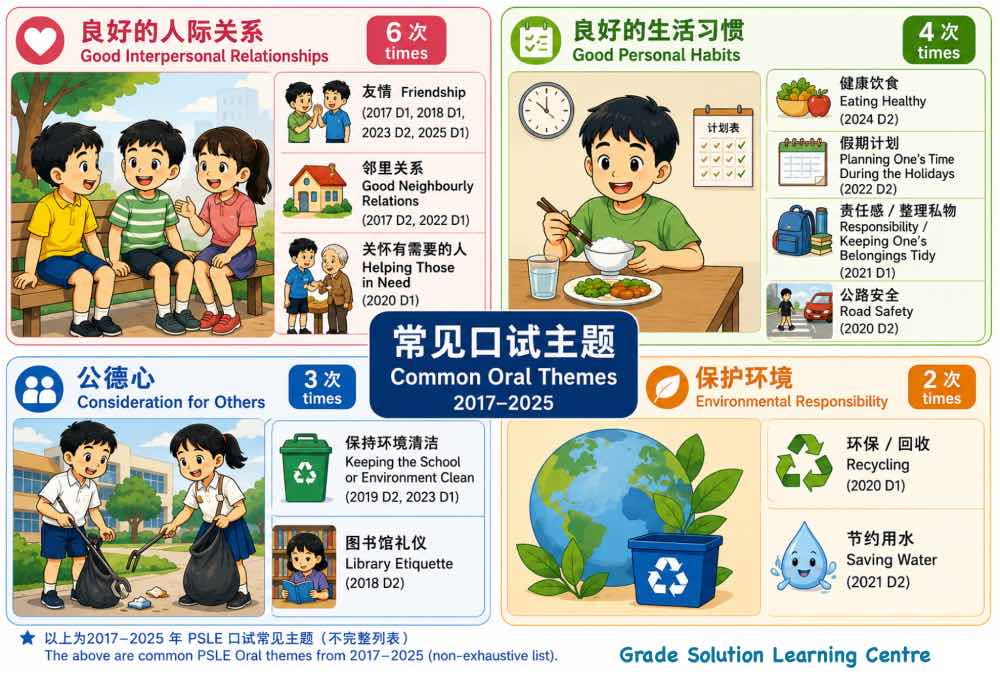
The list of topics is not exhaustive but if time is scarce, students should first focus on the above-listed areas.
Regular speaking practice is equally important. The more students speak Chinese aloud, the more natural and comfortable it becomes. Students who are less confident can begin with simpler questions or start by restating model answers before gradually progressing to more challenging ones. They should also focus on communicating their ideas clearly rather than striving for perfection. Making mistakes is a normal part of the learning process, and every practice session is an opportunity to improve.
Students can also develop a more positive mindset by giving themselves simple words of encouragement, such as reminding themselves that they have already done their best to prepare and are capable of tackling any questions.

During the examination, it is helpful to focus on expressing one’s ideas using the learnt answering frameworks rather than worrying about how the examiner may be judging them. Put the focus in the right place and relax. That will help ideas flow and their responses sound more natural.
Finally, becoming familiar with the examination format and procedures can greatly reduce uncertainty and anxiety. When students know what will happen during the examination, they are more likely to remain calm and confident. See our post on examination procedures for more details.
How Chinese Tuition Supports Oral Exam Preparation

Many parents are aware that their children need more oral practice but may not know where to begin. Likewise, students often find it difficult to identify or correct their own weaknesses. This is where structured Chinese oral lessons can help.
At Grade Solution, our oral and vocabulary programme focuses on answering techniques, vocabulary development, reading techniques and confidence-building. Students are exposed to a wide range of commonly tested themes and learn practical frameworks such as A SEAL to help them organise their responses clearly and logically. They also learn strategies to help them generate ideas when responding to challenging questions (like in Question 3).
More importantly, they receive regular opportunities to speak in Chinese in a supportive environment, with teacher feedback. Through real-world examples, guided practice and targeted feedback, students learn how to answer different question types, expand their responses, improve their fluency and communicate with greater confidence. Over time, this not only helps them perform better in oral examinations but also strengthens their overall Chinese language ability.
You can check out these other articles for more PSLE Chinese Tips:
Found this article helpful? Download a copy of it in PDF for future reference!

Follow Writing Samurai on Telegram for the latest tips and strategies for English, Chinese, and Creative Writing! Pssst... We will also share the latest compo topics during test or exam season!
Click this link to follow our channel >>> https://t.me/writingsamurai