
PSLE Marks Allocation and Format: A Complete Breakdown
Confused by the PSLE English format and unsure how each paper is scored?
You’re not alone. Thankfully, it’s more manageable than it looks. PSLE English isn’t one exam but several smaller papers, each testing a different skill and scored in its own way. This guide breaks down the marks and marking scheme paper by paper, so preparation stops feeling like guesswork and you know exactly where your child should focus.
This guide walks through all four papers, one component at a time: the marks, the timing, and what each section is really asking for.

PSLE English at a Glance
The examination assesses four language components and is marked out of 200. Each paper pulls a different weight and that weighting is the first clue to where preparation should focus.
|
PAPER |
COMPONENT |
MARKS |
WEIGHTING |
|
Paper 1 |
Writing |
50 |
25% |
|
Paper 2 |
Language Use and Comprehension |
90 |
45% |
|
Paper 3 |
Listening Comprehension |
20 |
10% |
|
Paper 4 |
Oral Communication |
40 |
20% |
|
Total |
|
200 |
100% |
The full official format, as published by the Singapore Examinations and Assessment Board (SEAB), is shown below.
EXAMINATION FORMAT
Candidates will be assessed in the following areas:
| PAPER | COMPONENT | ITEM TYPE | NO. OF ITEMS | MARKS | WEIGHTING | DURATION |
|---|---|---|---|---|---|---|
| 1 (Writing) |
Situational Writing | OE | 1 | 14 | 25% | 1 h 10 min |
| Continuous Writing | OE | 1 | 36 | |||
| 2 (Language Use and Comprehension) |
Booklet A: Grammar |
MCQ | 10 | 10 | 45% | 1 h 50 min |
| Vocabulary | MCQ | 5 | 5 | |||
| Vocabulary Cloze | MCQ | 5 | 5 | |||
| Visual Text Comprehension | MCQ | 5 | 5 | |||
| Booklet B: Grammar Cloze |
OE | 10 | 10 | |||
| Editing for Spelling and Grammar | OE | 10 | 10 | |||
| Comprehension Cloze | OE | 15 | 15 | |||
| Synthesis / Transformation | OE | 5 | 10 | |||
| Comprehension OE | OE | 10 | 20 | |||
| 3 (Listening Comprehension) |
Listening Comprehension | MCQ | 20 | 20 | 10% | About 35 min |
| 4 (Oral Communication) |
Reading Aloud | OE | 1 passage | 15 | 20% | About 10 min (5 min preparation time; about 5 min examination time) |
| Stimulus-based Conversation | OE | 1 photo stimulus | 25 | |||
| Total | 200 | 100% |
Legend:
MCQ Multiple-choice questions
OE Open-ended questions
PSLE English examination format · Source: SEAB
Paper 1: Writing (50 marks; 25%; 1 h 10 min)
Paper 1 contains two tasks: Situational Writing and Continuous Writing. Students are given 1 hour 10 minutes to complete both.
|
Situational Writing |
14 marks (7%) |
|
Continuous Writing |
36 marks (18%) |
Situational Writing – 14 marks
Students are provided with a context and a visual stimulus, and are required to write a response— usually an email, letter, or article. Of the 14 marks, 6 are awarded for Content and 8 for Language.
Students must understand the context, target audience and purpose of the response and address all content points; grammar and spelling errors are penalised.
A notable change in the latest syllabus is that one of the five or six required content points is now underlined. This point cannot be found in the given stimulus and requires students to supply their own relevant information.
The syllabus has also introduced a new text type: article writing. Unlike a letter or email written to a single recipient, an article is written for a broad, public audience such as schoolmates or neighbours, so it calls for a more engaging and persuasive tone.
Continuous Writing / Composition – 36 marks
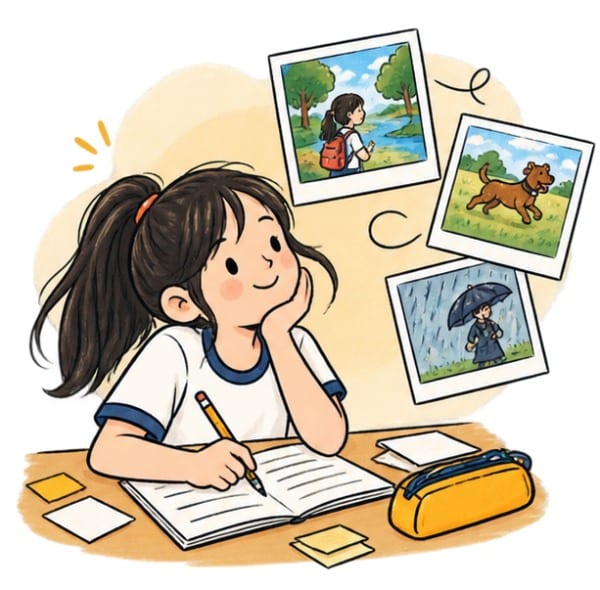
Students are given a topic and three pictures. They are to write a narrative of at least 150 words using one, two, or all three (not recommended) of the pictures. The 36 marks split evenly: 18 for Content, 18 for Language.
Strong content means a story that is creative, engaging, and well-developed. Strong language means a wide vocabulary, varied sentence structures, vivid descriptions, and accurate grammar and punctuation throughout.
Paper 2: Language Use and Comprehension (90 marks; 45%; 1 h 50 min)
The heaviest-weighted paper, spread across two booklets over 1 hour 50 minutes.
|
BOOKLET A · 25 MARKS |
|
|
Grammar MCQ |
10 |
|
Vocabulary MCQ |
5 |
|
Vocabulary Cloze MCQ |
5 |
|
Visual Text Comprehension MCQ |
5
|
|
BOOKLET B · 65 MARKS |
|
|
Grammar Cloze |
10 |
|
Editing for Spelling and Grammar |
10 |
|
Comprehension Cloze |
15 |
|
Synthesis and Transformation |
10 |
|
Comprehension (Open-Ended) |
20 |
Grammar MCQ · 10 marks
Ten questions on grammar concepts like subject-verb agreement, tenses, prepositions and more. Watch for tricky items on verbs of perception, perfect tenses, and gerunds.
Try It
A few dollars ________ all I had left in my wallet.
(1) is (2) are (3) was (4) were
Vocabulary MCQ · 5 marks
Five fill-in-the-blank questions where memorising vocabulary lists isn’t enough. Students must understand subtle differences between similar words and the meaning of idiomatic expressions.
Try It
His stirring speech ________ strong emotions from the audience.
(1) incurred (2) incited (3) evoked (4) evicted
Vocabulary Cloze MCQ · 5 marks
Students pick the best replacement for underlined words in a passage, weighing not just meaning but connotation and intensity.
Visual Text Comprehension MCQ · 5 marks
Two related texts appear: Text 1 is a visual (an advertisement, poster, or brochure) and Text 2 is text-based. At least one of the five questions asks students to compare the two.
Grammar Cloze · 10 marks
A passage with 10 blanks; students choose the correct word from a provided list for each gap, applying the same grammar rules as the MCQ section.
Editing for Spelling and Grammar · 10 marks
A passage with 10 words to correct, split evenly between grammatical and spelling errors.
Comprehension Cloze · 15 marks
One of the trickiest sections in Paper 2. Students read a passage and fill in 15 blanks with the most appropriate word, using contextual clues and forward-and-backward reading. Knowing synonyms, antonyms, collocations and phrasal verbs helps.
Synthesis and Transformation · 10 marks
Five questions worth 2 marks each: combine or rewrite sentences using a given word or phrase without changing the meaning. It tests reported speech, active and passive voice, conditionals, interchanging word forms, connectors, and relative pronouns.
Comprehension (Open-Ended) · 20 marks

Paper 3: Listening Comprehension (20 marks; 10%; about 35 min)
Twenty multiple-choice questions across about 35 minutes. Seven audio recordings (including advertisements, news reports, and interviews) are each played twice.
Best approach: scan the questions before each recording, listen actively, and jot down key points as you go.
Paper 4: Oral Communication (40 marks; 20%; about 10 min)
The oral has two parts: Reading Aloud and Stimulus-based Conversation. Since the latest syllabus revision, oral communication now carries a full 20% of the grade. That makes it far more valuable than many families treat it, and well worth real practice rather than leaving it to the day.
Reading Aloud · 15 marks
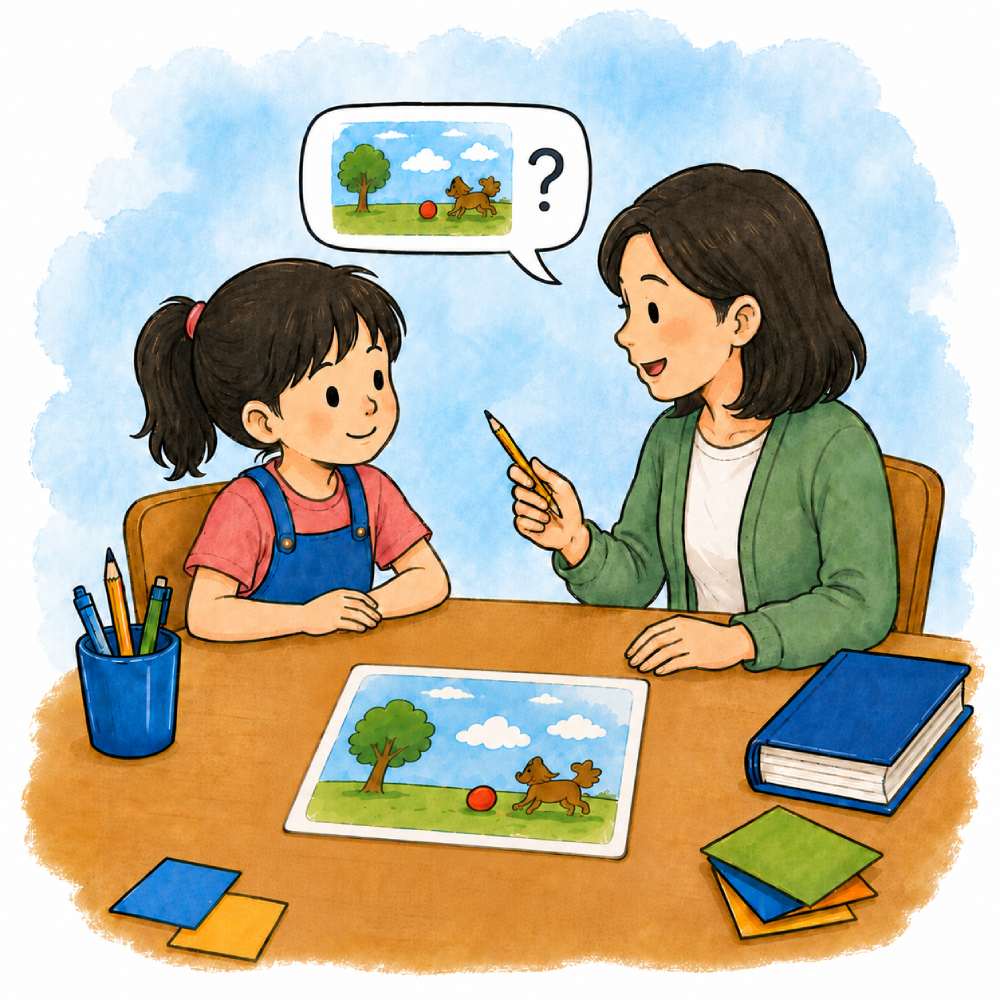
Stimulus-based Conversation · 25 marks
Frequently Asked Questions
How many papers are there in PSLE English?
Four: Paper 1 (Writing), Paper 2 (Language Use and Comprehension), Paper 3 (Listening Comprehension), and Paper 4 (Oral Communication). Together they are marked out of 200.
What are the main changes to the PSLE English format?
Oral is the big one. It is now worth 40 marks, a fifth of the whole grade, up from 30. To make room, Writing and Paper 2 each lost a few marks. Situational Writing was reworked and the oral was overhauled, while Listening stayed exactly as it was. For most families the point is simple: the speaking paper matters far more than it used to, and it is often the one left until last.
How has Situational Writing changed?
One of the content points is now underlined, which means the answer is not in the stimulus and the student has to come up with a relevant point themselves. There is also a new text type to watch for: article writing. An article is not addressed to one person the way a letter or email is; it is written for a wider audience, so the tone needs to be livelier and more persuasive.
Why is the PSLE English oral worth more now?
The oral was raised to 20% of the grade to put more weight on speaking well. Reading Aloud went up to 15 marks and now comes with a short preamble giving the purpose and audience, so reading accurately is no longer enough; the tone has to fit the situation. The conversation is worth 25 marks and uses a real photograph instead of a drawing.
Did the changes make PSLE English harder?
It is not harder, as long as students know what the tasks now ask for. Situational writing now has one underlined content point that is not in the stimulus, so the student has to think it up. And in the oral, Reading Aloud comes with a short preamble giving the purpose and audience, so it is no longer enough to read accurately; the tone has to fit. Once a student knows to expect these, neither is a real obstacle.
Preparing for Chinese too? Our Exam Tips for PSLE Chinese Paper 2 show your child where to focus.
Bringing it All Together
Understanding the format is the foundation of good preparation. Once you know what each of the four papers demands, you can point your child’s practice where it counts, instead of spreading effort thinly across everything.
For structured help with any component, explore our guides on composition writing, situational writing, and oral preparation. Each breaks down the techniques that move a child’s score the most!
Is your child stuck on how to start?
Try our Kickstart Your Writing Course. It teaches strong composition openings in about 30 minutes.
One exam, many skills — make sure none are left behind.
From grammar to oral communication, PSLE English tests a wide range of abilities. See how Grade Solution Learning Centre supports your child across every subject and skill, so no paper catches them off guard.
STAY IN THE LOOP
Follow us for more writing tips and vocabulary lists like this one.
Want to know what a good compo actually looks like?
Get the best compositions written by our students in this eBook!
*FREE for a limited time only!*
Let your child learn how to write awesome compositions that will WOW his or her teacher! (More than 12,815 students have benefited from this book!)
Click or Tap on the button below to download!


Follow Writing Samurai on Telegram for the latest tips and strategies for English, Chinese, and Creative Writing! Pssst... We will also share the latest compo topics during test or exam season!
Click this link to follow our channel >>> https://t.me/writingsamurai